
Where does the inefficient human fit in?
AI is all the rage. The tech giants of the world are locked in an all-out sprint toward AGI, each breakthrough celebrated like a moon landing, each release pushing the boundary of what machines can do. But amid the noise and momentum, it’s hard to ignore a familiar warning. As Dr. Ian Malcolm put it, “Your scientists were so preoccupied with whether or not they could, they didn’t stop to think if they should."
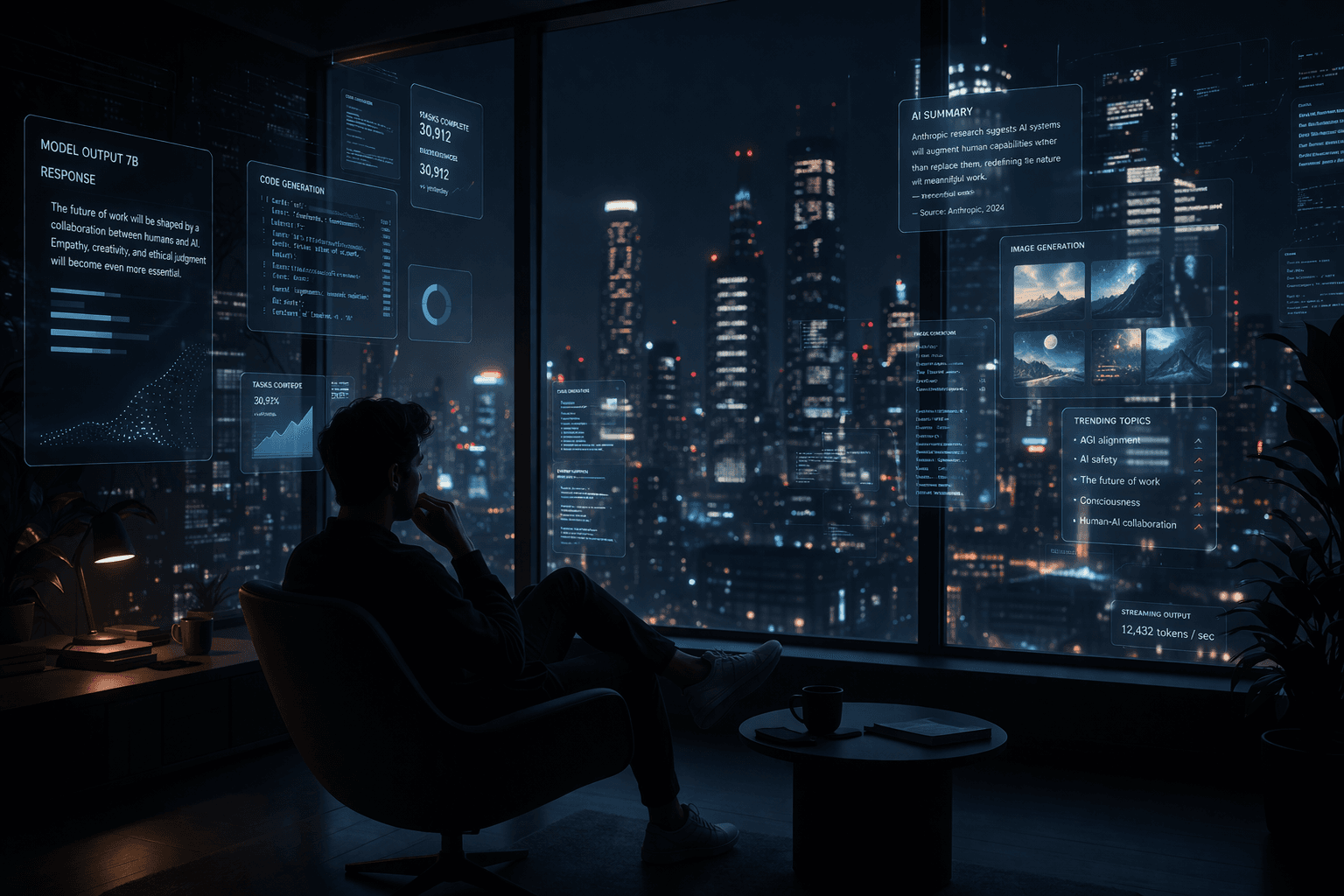
And that’s the tension shaping this moment. It is not just a race to build more powerful systems, it is a reckoning with what those systems bring with them. The question is no longer whether we can create something powerful. It is whether we are ready to live with the consequences.
For most of human history, inefficiency was not a flaw. It was the point. We wandered. We hesitated. We made mistakes and learned slowly. The messiness of being human, things like forgetfulness, emotion, bias, and curiosity, was not something to fix. It was the source of creativity and meaning.
Now we are building systems designed to remove all of that.
LLMs don't get tired. They don't second guess. They don't take time and marinate on problems like we do. They optimize, compress, and produce at a pace that makes human thinking feel vintage. In a world that increasingly values output above all else, how does the inefficient human fit in?
John Maynard Keynes once imagined a future where technology would give us a 15 hour workweek, leaving more room for what he called the art of life. Instead, we have often filled those gains with more work, higher expectations, and constant pressure. AI may push that even further. If machines can do in seconds what once took us hours, the bar doesn't lower, it rises.
Sam Altman, the CEO of OpenAI, once joked that AI might lead to the end of the world, but in the meantime there will be great companies. It sounds like humor, but the undertone is very real! The forces driving this technology are not philosophical. They are economic: speed, scale, and competition.
Compared to that, humans are slow. We stop and smell the roses.
Hannah Arendt warned about a world where efficiency replaces judgment, where thinking becomes secondary to process. She described something she called thoughtlessness. Not stupidity, but a lack of reflection. In many ways, highly efficient AI systems risk reinforcing exactly that. They can give us answers without understanding and decisions without real deliberation.
Humans, for all our inefficiencies, pause. We doubt. We change our minds. We keep asking why long after we have figured out how.
That matters.
Because intelligence is not only about producing the right answer. It is about context, meaning, and values. A model can write a perfect essay in seconds, but it does not care if it is true. It does not struggle with uncertainty or feel the cost of being wrong.
We do.
And that feeling, that friction, is where ethics lives.
There is also a deeper question underneath all of this. What are we actually trying to optimize for?
If the goal is pure efficiency, then humans start to look like a problem. We are inconsistent, emotional, and expensive. We need rest. We burn out. We argue and take detours. From a purely computational point of view, we are incredibly inefficient.
But if the goal is meaning, everything shifts.
Jaron Lanier, one of the early pioneers of virtual reality, has argued that technology should honor human dignity. It should not replace it or reduce it to data. It should support and amplify it.
The real risk is not that AI becomes more capable than we are. It is that we start judging ourselves by its standards.
When speed becomes the main measure, reflection starts to look like weakness. When output is everything, contemplation looks like wasted time. When optimization dominates, being human starts to look like a flaw instead of a feature.
And yet history tells a different story.
Every major technological shift has forced us to rethink what it means to be human. The industrial revolution replaced physical labor. The information age automated calculation and storage. Each time, humans did not become irrelevant. We shifted toward new kinds of meaning.
The question is not whether AI will outperform us at certain tasks. It already does. The real question is whether we let those tasks define our value.
Because the things that are hardest to automate are often the ones we overlook. Empathy. Taste. Judgment. Moral reasoning. The ability to sit with uncertainty.
The very things that make us inefficient.
So where does that leave us?
Not on the sidelines, but at the center, if we choose to be.
We are the ones who decide what problems matter. We define success. We live with the consequences. AI can generate possibilities, but it cannot tell us what they mean.
That is still up to us.
The future is not a simple story where humans either keep up or fall behind. It is something we shape. It reflects the choices we make and the values we prioritize.
We can build a world that strips away everything human in the name of efficiency.
Or we can build one that makes room for it.
And maybe that is the real question we should have been asking all along.
Not where the inefficient human fits in.
But whether we are willing to recognize that inefficiency is kind of what makes us human.